My attention is tossed about like a boat in a storm at times, while at others it is firmly and stubbornly anchored as a deeply rooted, 200 year-old oak. I oscillate easily between the two states as my passions wax & wane. This is an admonition that progress and quality of content will often come in fits of passion after lulls of inactivity, as I struggle with my many weakness – especially procrastination.
Furthermore, I must admit to suffering from a bit of pride when I was off to such a good start with the initial creation of this site. And is often the case, “Pride comes before the fall” — which actually come from Proverbs 16:18, 20.
Pride goeth before destruction: and the spirit is lifted up before a fall. It is better to be humbled with the meek, than to divide spoils with the proud.
…and fittingly, I crashed in my humility.
Originally I thought to myself, with hope in my heart:
If you build it they will come…
A sign of neuroses, perhaps. Of course, very few in fact came in the weeks that followed. Not much of a market for Latin – especially ecclesiastical in the form of an esoteric and obscure work such as Officia Pietatis. But that’s okay… I’ll continue to plug-away and eventually (perhaps), some will indeed come & return again to drink from the well of piety & wisdom of these two fine works: Officia Pietatis and The City of God.
There are two primary aims of my agenda that I have firmly in mind – The promotion of Christian Piety and the propagation of the use of Latin in and outside of the Church.
I began with sharing the devotional prayer book: Officia Pietatis back in mid-December. I put forth a surge of tremendous effort to get it off the ground and implemented the basic structure & design, fortifying it with some good content with many borrowed hours clocked after midnight.
Of course, burning the candle on both ends caught up with me and the wax was burned up within a few weeks and my production died for a good month. Work, family, sleep, and my athletic life suffered. I needed some rest and a reset. While I was neglecting the site for the past several weeks, I stumbled serendipitously upon an online reading of Saint Augustine’s “De Civitate Dei Contra Paganos” – or by its more familiar title – The City of God.
Using Twitter professionally and privately for a few years, I became aware of a rather bold experiment –masterminded by C. C. Pecknold, a professor of Systematic Theology at the Catholic University of American – someone I had never heard of before. He had a crazy idea to use Twitter as a means to drive readers far and wide to study and offer insight and commentary with the good professor, creating a new online community. But of all the social-media tools out there… Twitter? But upon reflection, I thought what a brilliant idea! Why not join in and see where it leads. One of the great things about Twitter is forces one to choose their words wisely & concisely. Taping into the Twitter world also affords a large pool of potential followers to join in the crusade. Picking such a monumental work as Augustine’s City of God – with its great depth and wide breadth as a work of literature, philosophy, theology in the form of a letter to Marcellinum, serving as an argument against Paganism and a defense of Christianity. This so-called letter became twenty-two books!
More often than not, I personally need a “forcing function” to get me to move forward on something I ought to be doing or acting upon things that would benefit me greatly or save me from some unpleasant consequence born out of sloth. Reading has never been a natural love of mine and neither has been running or a number of other pursuits, I find myself engaged. I am often triggered into action by external forces and not by any initiatives of my own. The concept of grace is something I have no trouble embracing due to this fact. I truly understand the concept more than many. This is because I realize any good in my life comes simply from God throwing a good dose of grace in my direction and clearly not from any work I have done or have merited on my part. I would love to take the credit for all the good I appear to have exercised… but I know rather clearly that it’s God’s efficacious grace working through me. On the other hand, I can readily take full-credit for my folly and failures – which are many, I assure you.
Forgive me, my mind often tends to wander off-topic, spending too much time tangentially. Let’s get back to the matter.
After reading the first 10 books of “The City of God” in both English and Latin, I decided to take the Latin text of the work I found online and do a couple of things:
♦ Create a personal Kindle Book to read, and later
♦ Publish the text here on the site.
The reason I created a Kindle version was that I could easily switch over to the Latin to compare against the English version I was reading. Also, leveraging the Latin dictionaries I installed, I could more easily parse and look up Latin words I am not familiar with or have slipped my mind. Furthermore, I could always publish it on Amazon to share with others later as well.
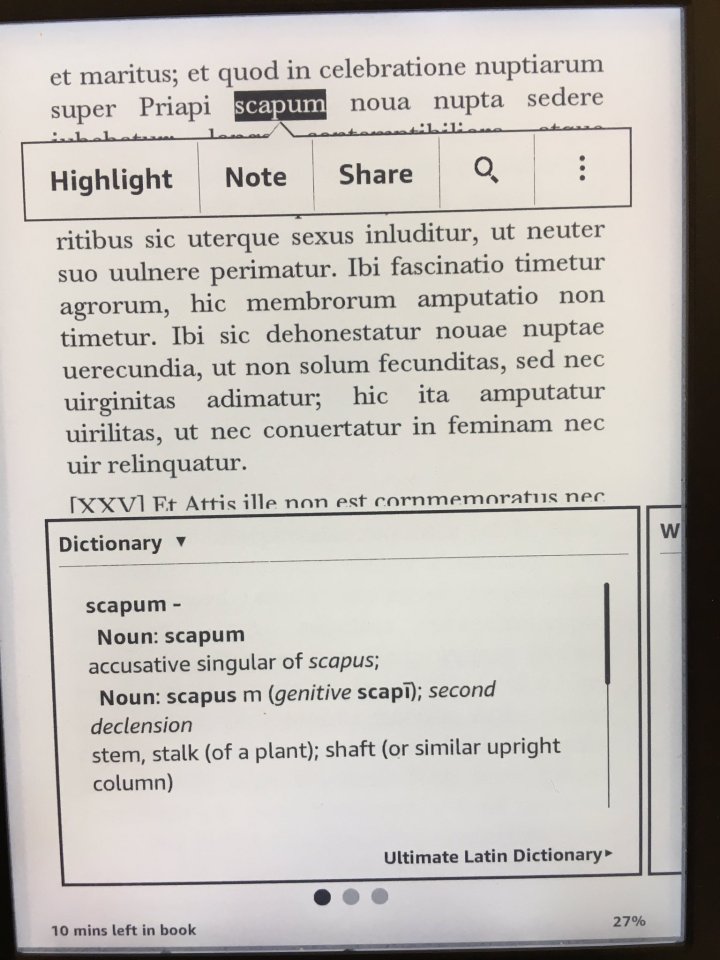
Luckily for me, all the text is available online, unlike Officia Pietatis where I had to type each and every word myself. To do the same, certainly, would have taken a few years for typing out De Civitate Dei – an 1,100 page book. Although I have the entire text, I found it unfortunately uses the “classical” rendering of the text. It uses letter v/V for the letter u/U. I imagine that the person responsible for getting the work online prefers this rendering, since the letter “u” did not exist in ancient Rome. The “Classicists” have promoted the disuse of the letter “u” and you can see this in their rendering of Augustin’s work. Personally, my taste for classical Latin was always bitter-sweet. I find the medieval & ecclesiastical Latin more to my taste for a couple of reasons. One and foremost, is for the love of the Church and two, for its greater simplicity and beauty of the sound of it’s Latin when reciting prayers or singing chant. As is the case in the singing of opera as it is with speaking and pronouncing Latin as the Church does in Her liturgy, the Italian phonetic is preferred to most with an appreciation of beauty. With my apology to any Germans reading this, the German-like rendering leaves much to be desired. No offense intended, I assure you. One exception I should mention is the signing of Beethoven’s Ode to Joy, but I digress, yet again.
One reason I haven’t dumped all the text up on the site “as is”, is that I wanted to go through all the text and insert all the “v’s” back into the work to provide a much easier reading of the text. I also have decided to use “j’s” for “I’s” as appropriate. Examples of this is the following:
| Words using V’s | Converted Form using W’s | Definition |
| Uideo | Video | I see |
| Uetere | Vetere | Old, ancient / forbid prohibit |
| Paruuli | Parvuli | Child, infancy, very young |
| Uiuens | vivens | Living, residing |
As you can see from the above table, reading Latin without “v’s” is a bit difficult until you train your eyes with a good dose of reading. The difficulty comes in the multi-syllabic words with many “u’s” that are the more problematic.
As for using “j’s” in place of “I’s” is more about being consistent and in line with most ecclesiastical works from the 17th and 18th centuries.
| Words using I’s | Converted Form using J’s | Definition |
| Maior | Major | Greater, bigger, broader |
| Iuventum | Juventum | Youth |
| Iuppiter | Juppiter | Roman God Juppiter |
| Iohannes | Johannes | John |
The work necessary to convert the text is cumbersome and has been taking me about four (4) hours per book. The time should decrease as I build my Latin dictionary in Word and as I do a Replace All as I go from one book to the next. A nice side effect is to make other ancillary corrections to the text that were introduced likely via OCR scanning that I have found. There will be things I miss of course. If you happen to notice anything, please inform me.
Please be patient… I will offer better navigation within the De Civitate Dei, after I get more of the text into the site. I hope to get a couple of books up on the site each week until it’s complete. I have added a General Index for each of the books and include them in the drop-down menu as well for a start. I also have been experimenting with HTML bookmarks for Chapters. You’ll notice that I have a link in the General Index for Book 10 to a separate page for all the chapters of that particular book. I’ll likely complete these toward the end of the project. I’ll add other navigational aides on the pages themselves as well. I welcome feedback on any ideas on improving the navigation — so fire away.
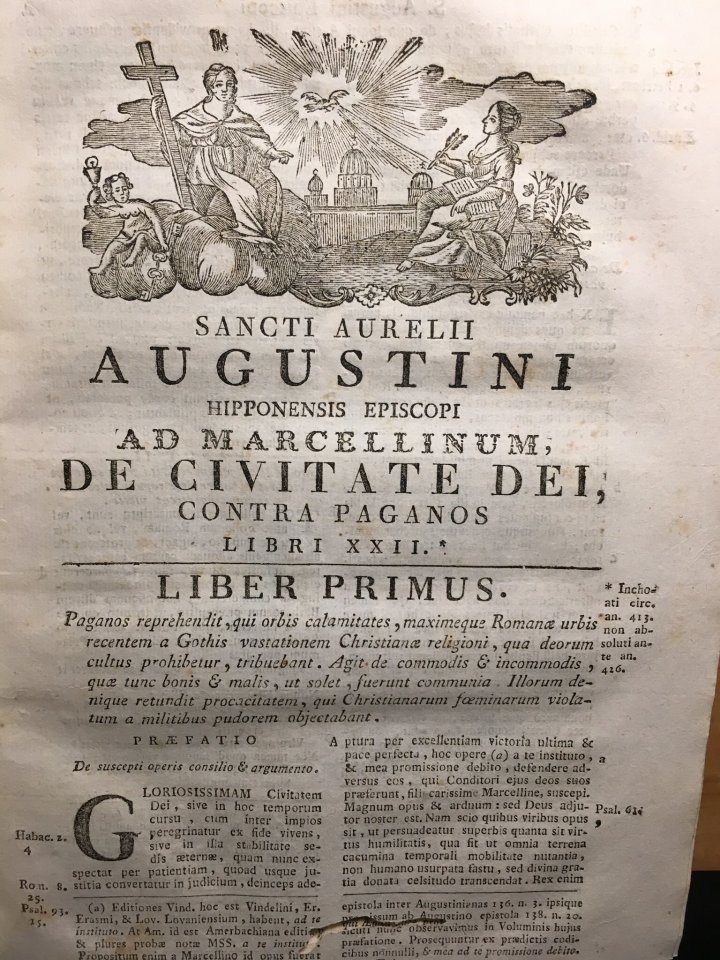
Another component I will add, and you can see parts of this now, is the use of the Maurist Edition of the work’s text. I happen to own a copy from 1809 and will type these additional texts out myself as well as some of the other unique features of the text – an example of which are the abstract summaries of the books and chapters in Latin. This is manageable I believe, but will require a good amount of time to complete.
To access the work you can use the menu above or click here.
I hope you find my publishing of the these works useful and efficacious toward serving you and your love of the Church and the good Lord. I also hope that it can also be a source of enjoyment of Latin itself – whether a new or highly developed skill you are cultivating. Whatever the case may be, I hope I can be encouraging at the very least.
May the peace and love of the Lord be with you, your families, and friends.
 OFFICIA PIETATIS CHRISTIANIÆ ERGA DEUM
Thanks for the update Mark
On Tue, Feb 21, 2017 at 8:52 PM, OFFICIA PIETATIS CHRISTIANIÆ ERGA DEUM wrote:
> Marcus Vincentius Augustinus posted: “My attention is tossed about like a > boat in a storm at times, while at others it is firmly and stubbornly > anchored as a deeply rooted, 200 year-old oak. I oscillate easily between > the two states as my passions wax & wane. This is an admonition that ” >
LikeLike