SUMMARY – Condensed Version
The creation of this site can be traced back to when I started collecting books about twenty years ago. Roughly, 14 years ago, after reading Homer’s Iliad & The Odyssey, I decided to learn Latin so that I could read Virgil’s continuation of the story in the original language – The Æneid. As I progressed, very slowly but steadily, I discovered that eBay had a much better selection of books in Latin to read than any bookstore – new or used. It was obvious that the largest selection of Latin was ecclesiastical – by a very large margin. I decided to purchase a book on Moral Theology by a Jesuit priest from the year 1748, bound in velum:
THEOLOGIA MORALIS UNIVERSA, written by R. P. Paulo Gabriele Antoine, SJ – a doctor of Sacred Theology and former professor.
A note inside the book fell out when I opened it. I picked it up and read it… Here’s a picture of the note: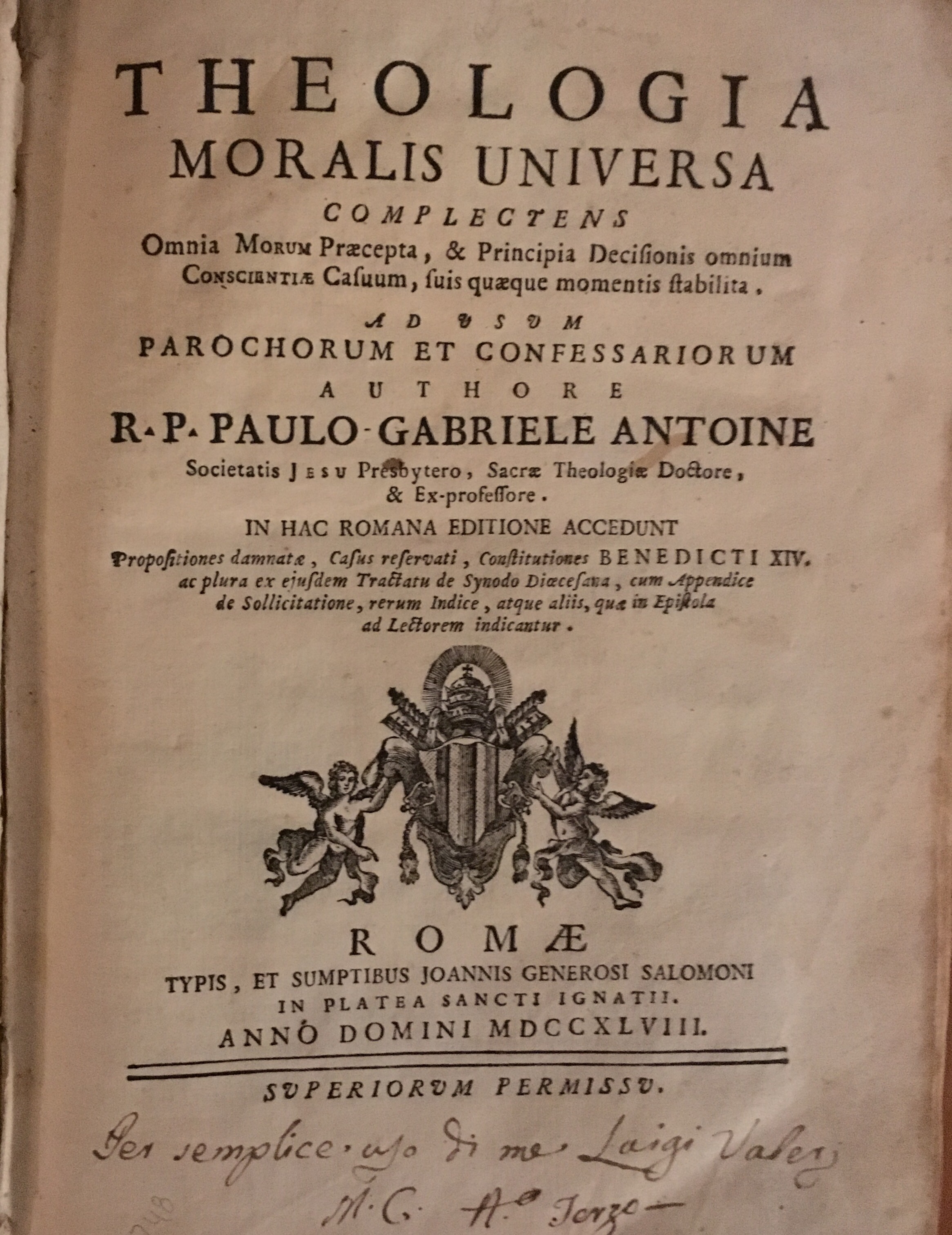
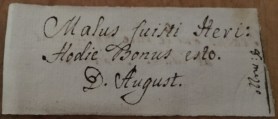
Translated, it reads: You were Bad/Evil Yesterday: Today be Good.
This was moment that the Lord gave me the greatest gift I have ever received – Faith! Something I never had, being a life-long agnostic. It was a call to convert or rather to revert – change my malevolent ways and stop being so self-absorbed and selfish…
I immediately began attending Mass and buying books, almost exclusively in Latin – mostly Theological in nature to augment my faith. Among the many prayer books I came across and purchased, I acquired this little prayer book that inspired me to create this site:
OFFICIA PIETATIS CHRISTIANÆ ERGA DEUM ET SANCTOS IN OCTO PARAGRAPHOS DISTRIBUTA ET AD USUM QUOTIDIANUM CHRISTI FIDELIUM IMPRESSA
Which translated reads:
The Duty of Pious Christians Toward God and the Saints Divided into Eight Sections and Printed for the Everyday Use of the Christian Faithful.
I take this prayer book everywhere… I read & pray with this book in order to prepare myself properly before the commencement of Mass, after receiving communion, and after Mass has ended – using the prayers of this book to give thanks. A year ago, I created a personal Kindle book – typing every single word, recreating the book electronically. I wrote a preface, a short biography of the author, and provided footnotes, etc. I have since wanted to translate the work to share with the world. It’s a very unique prayer book – it’s never been published in English. That’s a travesty that I am keen on changing!
While praying this morning before Mass, I was compelled to create this site as a sort of translation project. My plan is to reproduce the work here as I have done on the Kindle platform in Latin first. Then start the translation work – posting my thoughts and translation for review by those out there that can help render the work in English better than I could as an individual. Also, I will blog & reflect on passages in the book and people can comment and add to my thoughts. I am sure the project will evolve and hopefully be something of value to those that visit and ultimately contribute to the project.
If you are interested in the rest of the story, read on.
THE WHOLE STORY
As I mentioned above, I have been collecting books for a number of years now – somewhere near twenty – starting sometime in 1996. However, I was never a reader growing up. Rarely could a book hold my attention. I was a hyper-active child, who’s attention span was very short. Sports & playing outside with my friends occupied most of my time. I read Cliff Notes instead of books we were assigned to read in junior high & high school. I did read one novel on my own in junior high school. One day my class was in the library and I decided that I would read the thickest book I could find. What I found was the historical novel on the life of Michael Angelo, The Agony & the Ecstasy by Irving Stone. This was a rare exception as I persevered through many distractions of the mind and my tendency to daydream while my eyes continued to scan the page. I would find myself down a few paragraphs on the page and then having to go up to where I remembered last consciously reading. Luckily, I was very determined to finish the book and it was actually very interesting. Not until I attended college, would I read a novel from start to finish.
I was a Biology major, adding Philosophy to my studies later after falling in love with the subject. Again, I only read the books necessary to pass my classes – mostly text books which were mostly technical in nature. Sure, the occasional philosophical book. These work compendiums or excerpts. Works by Bertrand Russell and novels by Ayn Rand caught my interest, however and I did read them in their entirety. But never the great literary novels, created over the centuries, until about another ten years after completing my study at university.
Until… I received an offer from Easton Press to purchase a leather-bound copy of Moby Dick for a mere $9.99, if memory serves me – did I start to appreciate books. Using technology, I was aided in reading Melville’s great novel. That year, Microsoft released their encyclopedia, Encarta on CD which helped me to overcome two important barriers: 19th century vocabulary and ignorance of scripture. It was much faster to type in words I wasn’t familiar with and topics that I was never exposed to as well as the myriad hyper-links that provided fuller understanding of what I was reading – greatly enhancing the reading experience for someone like myself.
This led to accepting the terms that had me acquire a book every other month. The next book I received from Easton Press was Thoreau’s Walden – which I took along with me to Concord, Massachusetts where Thoreau build his little shack on Walden Pond in walking distance from where I was staying. I purposely stayed in Concord to read the book at the pond itself over the weekend after visiting clients in the Boston area. After taking a tour of Hawthorne’s home in Concord, and then visiting Salem where the House of Seven Gables was located along with the Custom-House. When I returned to my home, another book was waiting for me… Hawthorne’s The Scarlet Letter, believe it or not. I then received Thomas Hardy’s novel, The Return of the Native, then another, and another until I could no longer keep up my reading, as I had three different series of books on order at any given time. I now had a library… a small one, but a library nonetheless. I soon discovered the world of used book stores around the Seattle area and decided to collect the complete works of authors I loved. My library was growing in leaps and bounds after 10 years.
Then a strange thing happened. While in the office of a colleague, who was still in a meeting on the phone, I was looking around and saw a set of books on his shelf. The Iliad 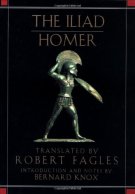 and The Odyssey by the Greek poet, Homer. I had these two books in my library, but I failed to read them. Not from a lack of trying. The prose translation of Homer’s two epics by the Englishman, Alexander Pope was just too difficult for me to hold my attention. Taking the Iliad down off the shelf, I opened it to the first page and began reading. This new translation by Robert Fagels sung to me in familiar modern English. I found a glossary to my delight with Greek pronunciation and short descriptions of the various Greek & Trojan characters of the book. Just what I needed to forge ahead and read these great works without suffering through Pope’s prose.
I purchased the Fagels’ translation of both works and as often happens when I buy books they sit on my shelf waiting to be read. In this case, a few months before I finall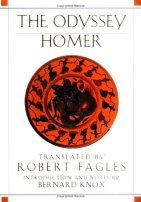 y read them. Once I started, I read voraciously finishing both books in a few days. I thought to myself many times, “wouldn’t be nice to read these in the original, Homeric Greek?” Not a chance in Hades was this going to happen, of course. Not having any natural talent for language acquisition, made this a fantasy at best. Homeric Greeks is probably the most difficult of ancient Greek languages. Much harder than Attic – the language of Plato & Aristotle, or Koine – the language used during Christ’s time and used to write the Septuagint. I couldn’t even master French after several attempts to learn to speak it during high school and college.
My struggle was speaking… not so much reading, per se. The Æneid was a natural next book to read after the Odyssey. So, I got this crazy notion that perhaps I could learn Latin – since much of the English language was composed of Latin root words – and read it in the original language, Latin.
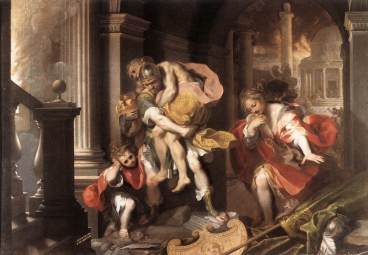
The Æneid was Virgil’s gift to Augustus Julius Caesar, Rome’s first true Emperor, continuing the story from the Iliad, after Troy is conquered by the Greeks. Æneas, the main character, escapes and flees Troy and travels to the coast of Latium, becoming the ancestor of the Romans. How cool would it be to read in Latin instead of English!
Luckily, at the time the internet was in full bloom, with a lot of great resources starting to appear. I found this website called Textkit – a forum for ancient Latin & Greek learning. There I got excellent advice and help. Before I discovered this wonderful site, I struggled mightily. I bought Wheelock’s Latin – a textbook I suffered through when I progressed to the various ablative forms like the absolute. Remember, language and me have a rather challenging and difficult relationship. The utmost patience, diligence, and care – and hence time is required for me to move past the many obstacles she may place in my path to frustrate my pursuit of her. Ablatives and subjunctives were certainly the stones that slowed me down. Next I had it a bit easier after going through some other text books I found on eBay with the discovery of the Cambridge Latin Course Series. This is a dumbed down series – which was perfect for me. I was able to get through the entire series of books, numbering 5 in a few months time.
But I was still having difficulty with the language… as I started to read the Æneid, I still struggled. I then started to buy children’s classics to enliven my learning experience. These, starting to appear in some number, translated into Neo-Latin, or more properly, living or contemporary Latin. Latin that is made up to 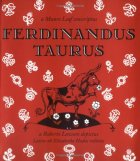 account for modern day concepts and colloquialisms… Here is a search on Amazon for Children’s Books in Latin, here. Winnie the Poo, Cat in the Hat, The Grinch that Stole Christmas, Ferdinand the Bull – or in Latin, Ferdinandus Taurus – one of my favorites. I even purchased the Harry Potter – The Philosopher’s Stone. Which by the way, is really
 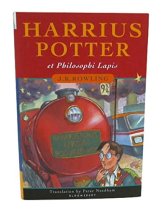 hard to read in Latin. All these made up words or old Latin words with newly contrived meanings, making the reading tortuous at times- at least for me.
I jumped from text book to text book, from children’s book to children’s book – slowly but surely making some progress but I still could progress in a meaningful and to me a measurable way. I felt stuck in elementary Latin. Real Latin, from Cicero to Cæsar; the Æneid was still eluding me.
But some help was just around the corner… Someone at the Textkit forum suggested Hans Ørberg’s Lingua Latina Per Se Illustrata, based on the Natural Method of learning languages. The opening lines are as follows: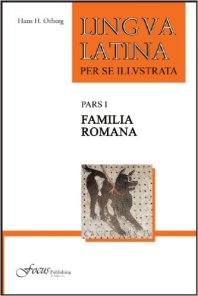
Roma in Italia est. Italia in Europa est. Græcia in Europa est. Italia et Græcia in Europa sunt. Hispania quoque in Europa est. Hispania et Italia et Græcia in Europa sunt. Ægyptus in Europa non est.
You start simply, like we did as kids learning to read.
…To be continued as I construct the site. This is a test post at this point. 🙂
 OFFICIA PIETATIS CHRISTIANIÆ ERGA DEUM
Test comment to myself… The site has made quite a bit of progress in such a short time span – 3 days!
LikeLike
Very interesting and impressive projects that you’ve undertaken!
You have the Maurist edition of de Civitate Dei? or Migne’s republication in Patrologia Latina? Am jealous; I must alas consult the Fathers mostly via Documenta Catholica Omnia online, although have been using Dombart, Kalb (also online) for the current reading chez #CivDei.
LikeLike
Yes, I have the 1809 Maurist edition of Civitatate Dei -Ex Accurata Editione Monachorum Ordinis S. Benedicti Congrationis S. Mauri deprompta.
My plan for CivDei is to use the text as a base from http://www.thelatinlibrary.com/august.html and purge from it the classical spellings (e.g. vere for uere) and incorporate elements from the Maurist ed. over time. I’ll improve the navagation as well by adding an index of the Books and their respective chapters. Much later, I hope to add footnotes, a Pio Lectori (a note from me to the Pius Reader), as well as a De Authore (a short biography about the author) as I done with my rendering of Officia Pietatis here.
LikeLike